We are frighteningly close to senior year, as we are reminded just about daily by the faculty who used to say "When you're in the clinics next year" and now say "When you're in the clinics in a few weeks." (At which we cringe in unison, cover our ears, and go to a happy place.)
Here are some numbers to give you an idea of what the rest of my semester looks like:
2 more weeks of junior practicum in the morning, including 5 mornings of client communications and 5 mornings of independent study in ophthalmology
2 papers to be written next week for client communications
3 more weeks of classes in the afternoon, including 30 more hours of lecture
4 more exams in Small Animal Med/Sx II
4 more "closed-book homework assignments" (= "quizzes") in Small Animal Med/Sx II
1 final in animal behavior
1 animal behavior case study paper to write
17 days(!) until our 12 hours of capstone exam begin (OK, I'm freaking out just a little bit)
125 lectures from last semester that I'd love to at least pretend to study before capstone (13 down -- gotta start somewhere)
27 days(!!!) until our first day in the clinics as seniors
Which for me means potentially 31-32 days until I start spaying and neutering dogs and cats all by my very lonesome. Yeek.
And a partridge in a pear tree.
Friday, April 15, 2011

Squeeee
I had the keeee-yoo-test little itty bitty baby puppy to anesthetize yesterday. Teensy "Molson," pictured here:
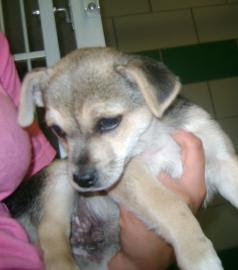
is a 9 week old, 4 1/2 lb sweet little German shepherd(?)-Husky(?) mix who came to the VTH in dire need of removal of his eensy-weensy testicles.
My other 5 cases on clinical anesthesia and Surgery C were all basically adult animals ranging from 12-180 lb, so I was a little nervous about anesthetizing such a tiny pediatric.
Fortunately, Molson did great with an atropine/hydromorphone pre-med, ketamine/valium induction, lidocaine intratesticular block, and some meloxicam and more hydro post-op. I got a 22g IV catheter into him after a couple tries (he got ferocious when I swabbed his leg with alcohol! What a tough puppy!) and successfully intubated him with a wee little 4.5 ET tube. He stayed pretty warm (thanks to a warm water blanket and a handy dandy heat lamp) and kept his heart rate up between 130 and 170. His blood pressure even stayed in a decent range, which can be an issue with pediatric patients. He was lounging in a pile of blankets and towels, basking in the glow of another heat lamp when I left him in the humane society ward. He's going to find an awesome home and grow up to be a fantastic doggie, I just know it!

is a 9 week old, 4 1/2 lb sweet little German shepherd(?)-Husky(?) mix who came to the VTH in dire need of removal of his eensy-weensy testicles.
My other 5 cases on clinical anesthesia and Surgery C were all basically adult animals ranging from 12-180 lb, so I was a little nervous about anesthetizing such a tiny pediatric.
Fortunately, Molson did great with an atropine/hydromorphone pre-med, ketamine/valium induction, lidocaine intratesticular block, and some meloxicam and more hydro post-op. I got a 22g IV catheter into him after a couple tries (he got ferocious when I swabbed his leg with alcohol! What a tough puppy!) and successfully intubated him with a wee little 4.5 ET tube. He stayed pretty warm (thanks to a warm water blanket and a handy dandy heat lamp) and kept his heart rate up between 130 and 170. His blood pressure even stayed in a decent range, which can be an issue with pediatric patients. He was lounging in a pile of blankets and towels, basking in the glow of another heat lamp when I left him in the humane society ward. He's going to find an awesome home and grow up to be a fantastic doggie, I just know it!
Of course he's cute!
Bullwinkle, my sweet little anesthesia case from Tuesday, is now up for adoption and looking ever so darling (OK, maybe "darling" is a matter of opinion) in his adoption photo:
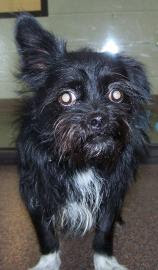
He's cute, I swear! I know he'll find a great family who appreciates his one-of-a-kind looks.

He's cute, I swear! I know he'll find a great family who appreciates his one-of-a-kind looks.
Monday, April 11, 2011
Bullwinkle!
I'm on surgery C for anesthesia this week, meaning I'm assigned to my very own humane society anesthetic case tomorrow and Thursday, and my very own client-owned spay/neuter patient on Wednesday.
Tomorrow's patient, "Bullwinkle," is a scruffy little mutt dog, about 12 pounds, mostly black with a little white on his chest, with long wiry hair and two very large testicles. He's about a year old -- estimated only, because he was left overnight at one of the local humane societies. :(
I have to say: Bullwinkle's only chance at upcoming adoption is for someone to fall in love with his "quirky" appearance. I say "quirky," because it doesn't seem very politically correct to say what my anesthesia rotation-mate said when she saw him: "Oh my god! Your dog looks like a retard!"
True, Bullwinkle must have come from a motley line of cross-bred dogs, with nary a purebred ancestor in sight. True, his eyes do bug out of his head, one more than the other. And yes, he has one ear that stands straight up and one ear that flops over. And I'll admit that when he looks directly at you, you can't avoid a shiver of crazy running down your spine.
But he's sweet! Okay, he's really scared and doesn't want to look at you, or come near you. And if you put a leash or collar on him, he melts to the floor and magically weighs 80 pounds. But he let me pick him up and put him on my lap, and didn't try to get away. He's one of those "I'm so freaked out I can't move but I don't think I'm going to bite you" dogs. So I'm not sure anyone will fall in love with him based on his personality, unless he really warms up once he gets de-testicled.
I have a sterling anesthetic management plan worked out for him, including some acepromazine, atropine, and morphine as pre-meds; ketamine/diazepam for induction; isoflurane maintenance; an intratesticular lidocaine block; and carprofen/morphine injections post-op with his senior Community Practice student choosing what oral NSAIDs he'll take home with him. Doses and rates are calculated out for oxygen flow, IV fluids, and atropine/dobutamine/ephedrine if needed to help with his heart rate or blood pressure. He'll get a pulse oximeter, capnograph, EKG, Doppler blood pressure, and temperature probe to make sure he's doing well while asleep.
Here's hoping Bullwinkle's surgery goes well tomorrow, and that he doesn't try to give me a heart attack while I'm managing his anesthesia! Despite his "unique" looks, I'm starting to like him...
Tomorrow's patient, "Bullwinkle," is a scruffy little mutt dog, about 12 pounds, mostly black with a little white on his chest, with long wiry hair and two very large testicles. He's about a year old -- estimated only, because he was left overnight at one of the local humane societies. :(
I have to say: Bullwinkle's only chance at upcoming adoption is for someone to fall in love with his "quirky" appearance. I say "quirky," because it doesn't seem very politically correct to say what my anesthesia rotation-mate said when she saw him: "Oh my god! Your dog looks like a retard!"
True, Bullwinkle must have come from a motley line of cross-bred dogs, with nary a purebred ancestor in sight. True, his eyes do bug out of his head, one more than the other. And yes, he has one ear that stands straight up and one ear that flops over. And I'll admit that when he looks directly at you, you can't avoid a shiver of crazy running down your spine.
But he's sweet! Okay, he's really scared and doesn't want to look at you, or come near you. And if you put a leash or collar on him, he melts to the floor and magically weighs 80 pounds. But he let me pick him up and put him on my lap, and didn't try to get away. He's one of those "I'm so freaked out I can't move but I don't think I'm going to bite you" dogs. So I'm not sure anyone will fall in love with him based on his personality, unless he really warms up once he gets de-testicled.
I have a sterling anesthetic management plan worked out for him, including some acepromazine, atropine, and morphine as pre-meds; ketamine/diazepam for induction; isoflurane maintenance; an intratesticular lidocaine block; and carprofen/morphine injections post-op with his senior Community Practice student choosing what oral NSAIDs he'll take home with him. Doses and rates are calculated out for oxygen flow, IV fluids, and atropine/dobutamine/ephedrine if needed to help with his heart rate or blood pressure. He'll get a pulse oximeter, capnograph, EKG, Doppler blood pressure, and temperature probe to make sure he's doing well while asleep.
Here's hoping Bullwinkle's surgery goes well tomorrow, and that he doesn't try to give me a heart attack while I'm managing his anesthesia! Despite his "unique" looks, I'm starting to like him...
Why yes, I WOULD like a scholarship!
After last year's traumatic non-scholarship-experience detailed here, and an even-more-pathetic-than-usual essay submitted with my scholarship application last November, I finally got a scholarship!
OK, now that you're done cheering, the relevant details are: $2200 (yes! would have been happy with $50!), 9 other people got the same scholarship as me (holy rich people), it's only for junior students, and the criteria were "superior scholarship, initiative, perseverance, potential for leadership, and financial need." I'm going to pretend that I qualified for more of that than just "financial need."
So I joined many of my fellow junior, sophomore, and freshman classmates, as well as some biomedical sciences undergrads, to nosh on a pretty display of fruit, cheese, crackers, and cookies, accompanied by "golden punch" (which I'm 97% sure was straight orange juice) and listen to a 25-second congratulatory speech by the dean of the vet school.
Interesting statistic: apparently there are 440-some scholarships given out every year to vet students and biomed undergrads, totally some $1.6 million dollars annually. Wow. (And also, why haven't I seen some of this money before?? That comes out to about $2700/year per student!)
Anyway, I'm thoroughly satisfied by my scholarshippiness and look forward to the receipt of $2200 to help offset my upcoming tuition bill of $51,000 for senior year.
OK, now that you're done cheering, the relevant details are: $2200 (yes! would have been happy with $50!), 9 other people got the same scholarship as me (holy rich people), it's only for junior students, and the criteria were "superior scholarship, initiative, perseverance, potential for leadership, and financial need." I'm going to pretend that I qualified for more of that than just "financial need."
So I joined many of my fellow junior, sophomore, and freshman classmates, as well as some biomedical sciences undergrads, to nosh on a pretty display of fruit, cheese, crackers, and cookies, accompanied by "golden punch" (which I'm 97% sure was straight orange juice) and listen to a 25-second congratulatory speech by the dean of the vet school.
Interesting statistic: apparently there are 440-some scholarships given out every year to vet students and biomed undergrads, totally some $1.6 million dollars annually. Wow. (And also, why haven't I seen some of this money before?? That comes out to about $2700/year per student!)
Anyway, I'm thoroughly satisfied by my scholarshippiness and look forward to the receipt of $2200 to help offset my upcoming tuition bill of $51,000 for senior year.
Sunday, April 10, 2011
Welcome to anesthesia
I'm in between my 2 consecutive weeks of junior anesthesia rotation -- our only junior practicum rotation other than client communications that comprises more than a single week during the year.
Anesthesia is reputed to be one of the more challenging, time-consuming, and stressful, yet thought-provoking, interesting, and rewarding rotations we get to have during junior year. My 2-week block is the second-to-last of the academic year, meaning I've heard feedback from almost all of my classmates up to this point.
The dozen of us who started anesthesia last week showed up outside of room D107D shortly before 8 am, as instructed by the first page of our orientation packet that was delivered to our mailboxes the previous week, with "8 am on Monday, room D107D" highlighted for us in bright yellow.
Unfortunately, by 8 am, no instructor had arrived to unlock the door to the room we were supposed to be in, much less give us an actual orientation. Being good little vet students and understanding that clinicians and support staff can be very busy and the hospital has a priority to patient care as well as student learning, we sat patiently in the hallway for another 15 minutes.
At 8:15, I walked across the hospital to the anesthesia induction/recovery area to see if anyone might know what we were supposed to be doing. I found the anesthesia prep room as well as the rounds room completely unoccupied, so went to rejoin my classmates in our continuing exercise in patience.
At 8:30, nothing had changed, so I made the rounds again, and again found the prep room and rounds room with nary an anesthesia clinician or nurse in sight. Back I went to room D107D.
At 8:50 am, the surgical instructor who works with the spay/neuter cases seen on Community Practice came walking down our hallway, and we pretty much pounced on her to help us. Being a helpful person, she first let us into the room we were waiting in front of, and then paged the nurse who was supposed to be leading our orientation. The news she found out was that said orientation nurse had called in sick and advised whomever she talked to that she would be unable to lead junior orientation and they would have to find someone else to do it. Seems that message never got conveyed to anyone who might actually be interested in leading our orientation.
The kindly surgical instructor marched upstairs to where she knew all of the anesthesia faculty and nurses were listening to a guest lecturer give a presentation, hoping to snag one of them to come give us a hand. However, she returned at 9 am with the news that, despite having interrupted their meeting and advised them that a dozen juniors had been waiting for over an hour for the anesthesia orientation they had been commanded to appear for by an annoyingly highlighted orientation packet, the meeting was apparently so important and/or interesting that not a single person would be able to break away from it to come orient us. Word was that the meeting would be over at 9:30 am and orientation would commence at that point.
Fast forward after killing time for half an hour. We dozen students again await an instructor at 9:30 am. Finally, at 9:50 am (bearing in mind that we all showed up roughly 2 hours before this point), a couple of anesthesia nurses walked in nonchalantly with no apologies and proceeded to give us their version of "orientation" ("Keep in mind that we've never done an orientation before and we don't really know what they tell you... but we can show you where the equipment is"). An hour and 15 minutes later (including a 30 minute antiquated video of how to place an IV catheter and induce anesthesia, using protocols that probably haven't been used at the teaching hospital in the last 15 years), we had apparently received all of the orientation we needed.
The nurses asked if there were any questions, and we proceeded to spend another 30 minutes asking them about tons of relevant information they had neglected to mention during "orientation." We then went on our merry way, thoroughly confused about anesthesia rotation.
In discussing with some of my other classmates over lunch, almost all of them said their orientation was very thorough and had taken the full 4 hours allotted, sometimes even spilling over into the lunch hour, and leaving the juniors confident in how the following two weeks would go. Haha. I'm sure we didn't miss anything in our 75 minute "we don't know how to do orientation" orientation. Good thing it's not like anesthesia is a department in which patients' lives are at risk and juniors are expected to devise their own anesthetic protocols and run anesthesia on their own. Oh wait.
Long story short, we clinical juniors (6 of us, including me, spent the past week shadowing seniors on more complicated cases, while the other 6 were on 'surgery C' -- the humane society spay/neuter cases) figured out what we were doing after sort of muddling our way through it on the first day.
On Tuesday I had a 50kg female great Dane undergoing a laparoscopy-assisted gastropexy (preventative surgery for bloat/GDV). She was totally anxious and freaked out when her owner dropped her off (sexually intact because "I want to show her and breed her" -- good luck getting her into a show ring without biting anyone). She fortunately sedated well with her pre-meds, and went down easily at induction. The surgery and anesthesia were uneventful, but she totally flipped out in recovery, 110 lb of panicked, disoriented dog flailing around and trying to bite. Hooray for alpha2 agonists that knocked her right out again.
On Wednesday my case was another great Dane -- this time 80kg (176 lb) -- in through Community Practice for the removal of a couple of probably benign but totally gnarly-looking skin masses growing on stalks off of his elbows. He was somewhat friendlier than the previous day's Dane, but still nervous, and didn't sedate as well before induction. However, he went under smoothly and recovered smoothly, which was a huge relief after seeing the previous day's recovery.
On Thursday I followed along with a 9 year old Australian cattle dog cross undergoing surgical repair for an acutely ruptured ACL. She had a TPLO (a procedure in which the bone of the tibia is cut and a steel plate is put on it) as well as a lateral suture to add stability to her knee. Those are potentially very painful procedures, so it was lovely that she received a femoral and sciatic nerve block on the affected leg, which kept her from feeling anything at all during surgery and kept her anesthesia very smooth. Like Wednesday's Dane, this dog didn't sedate especially well with pre-meds, but did induce smoothly. Her surgery went on for a long time so I didn't get to see her recovery.
This week I'm heading into my surgery C cases. Monday and Friday will be case discussions and rounds all morning, and I'll manage my own cases (with no assistance from a senior student) on Tues-Wed-Thurs. Tuesday and Thursday are humane society animals that go back to be adopted; Wednesday is client owned animals. They should all be spays or neuters on relatively young, healthy patients, which can theoretically make the anesthesia more straightforward, but we're still learning and there are always plenty of things that can go wrong in any anesthetic case, so it will be a challenging but hopefully rewarding experience (and I'm trying to put out of my mind my classmate whose very first surgery C case last fall died under anesthesia and couldn't be recovered... la la la, I can't hear you!). The downside is that on surgery days, I'll have to have my anesthetic plan approved BY 7 am (which means I have to get to school in time to put away my stuff, change into scrubs, get my clinic smock/thermometer/stethoscope/watch/etc., and get downstairs to have the nurse look over my anesthetic plan by 7 am). Sleep is overrated. Or so I keep telling myself.
Anesthesia is reputed to be one of the more challenging, time-consuming, and stressful, yet thought-provoking, interesting, and rewarding rotations we get to have during junior year. My 2-week block is the second-to-last of the academic year, meaning I've heard feedback from almost all of my classmates up to this point.
The dozen of us who started anesthesia last week showed up outside of room D107D shortly before 8 am, as instructed by the first page of our orientation packet that was delivered to our mailboxes the previous week, with "8 am on Monday, room D107D" highlighted for us in bright yellow.
Unfortunately, by 8 am, no instructor had arrived to unlock the door to the room we were supposed to be in, much less give us an actual orientation. Being good little vet students and understanding that clinicians and support staff can be very busy and the hospital has a priority to patient care as well as student learning, we sat patiently in the hallway for another 15 minutes.
At 8:15, I walked across the hospital to the anesthesia induction/recovery area to see if anyone might know what we were supposed to be doing. I found the anesthesia prep room as well as the rounds room completely unoccupied, so went to rejoin my classmates in our continuing exercise in patience.
At 8:30, nothing had changed, so I made the rounds again, and again found the prep room and rounds room with nary an anesthesia clinician or nurse in sight. Back I went to room D107D.
At 8:50 am, the surgical instructor who works with the spay/neuter cases seen on Community Practice came walking down our hallway, and we pretty much pounced on her to help us. Being a helpful person, she first let us into the room we were waiting in front of, and then paged the nurse who was supposed to be leading our orientation. The news she found out was that said orientation nurse had called in sick and advised whomever she talked to that she would be unable to lead junior orientation and they would have to find someone else to do it. Seems that message never got conveyed to anyone who might actually be interested in leading our orientation.
The kindly surgical instructor marched upstairs to where she knew all of the anesthesia faculty and nurses were listening to a guest lecturer give a presentation, hoping to snag one of them to come give us a hand. However, she returned at 9 am with the news that, despite having interrupted their meeting and advised them that a dozen juniors had been waiting for over an hour for the anesthesia orientation they had been commanded to appear for by an annoyingly highlighted orientation packet, the meeting was apparently so important and/or interesting that not a single person would be able to break away from it to come orient us. Word was that the meeting would be over at 9:30 am and orientation would commence at that point.
Fast forward after killing time for half an hour. We dozen students again await an instructor at 9:30 am. Finally, at 9:50 am (bearing in mind that we all showed up roughly 2 hours before this point), a couple of anesthesia nurses walked in nonchalantly with no apologies and proceeded to give us their version of "orientation" ("Keep in mind that we've never done an orientation before and we don't really know what they tell you... but we can show you where the equipment is"). An hour and 15 minutes later (including a 30 minute antiquated video of how to place an IV catheter and induce anesthesia, using protocols that probably haven't been used at the teaching hospital in the last 15 years), we had apparently received all of the orientation we needed.
The nurses asked if there were any questions, and we proceeded to spend another 30 minutes asking them about tons of relevant information they had neglected to mention during "orientation." We then went on our merry way, thoroughly confused about anesthesia rotation.
In discussing with some of my other classmates over lunch, almost all of them said their orientation was very thorough and had taken the full 4 hours allotted, sometimes even spilling over into the lunch hour, and leaving the juniors confident in how the following two weeks would go. Haha. I'm sure we didn't miss anything in our 75 minute "we don't know how to do orientation" orientation. Good thing it's not like anesthesia is a department in which patients' lives are at risk and juniors are expected to devise their own anesthetic protocols and run anesthesia on their own. Oh wait.
Long story short, we clinical juniors (6 of us, including me, spent the past week shadowing seniors on more complicated cases, while the other 6 were on 'surgery C' -- the humane society spay/neuter cases) figured out what we were doing after sort of muddling our way through it on the first day.
On Tuesday I had a 50kg female great Dane undergoing a laparoscopy-assisted gastropexy (preventative surgery for bloat/GDV). She was totally anxious and freaked out when her owner dropped her off (sexually intact because "I want to show her and breed her" -- good luck getting her into a show ring without biting anyone). She fortunately sedated well with her pre-meds, and went down easily at induction. The surgery and anesthesia were uneventful, but she totally flipped out in recovery, 110 lb of panicked, disoriented dog flailing around and trying to bite. Hooray for alpha2 agonists that knocked her right out again.
On Wednesday my case was another great Dane -- this time 80kg (176 lb) -- in through Community Practice for the removal of a couple of probably benign but totally gnarly-looking skin masses growing on stalks off of his elbows. He was somewhat friendlier than the previous day's Dane, but still nervous, and didn't sedate as well before induction. However, he went under smoothly and recovered smoothly, which was a huge relief after seeing the previous day's recovery.
On Thursday I followed along with a 9 year old Australian cattle dog cross undergoing surgical repair for an acutely ruptured ACL. She had a TPLO (a procedure in which the bone of the tibia is cut and a steel plate is put on it) as well as a lateral suture to add stability to her knee. Those are potentially very painful procedures, so it was lovely that she received a femoral and sciatic nerve block on the affected leg, which kept her from feeling anything at all during surgery and kept her anesthesia very smooth. Like Wednesday's Dane, this dog didn't sedate especially well with pre-meds, but did induce smoothly. Her surgery went on for a long time so I didn't get to see her recovery.
This week I'm heading into my surgery C cases. Monday and Friday will be case discussions and rounds all morning, and I'll manage my own cases (with no assistance from a senior student) on Tues-Wed-Thurs. Tuesday and Thursday are humane society animals that go back to be adopted; Wednesday is client owned animals. They should all be spays or neuters on relatively young, healthy patients, which can theoretically make the anesthesia more straightforward, but we're still learning and there are always plenty of things that can go wrong in any anesthetic case, so it will be a challenging but hopefully rewarding experience (and I'm trying to put out of my mind my classmate whose very first surgery C case last fall died under anesthesia and couldn't be recovered... la la la, I can't hear you!). The downside is that on surgery days, I'll have to have my anesthetic plan approved BY 7 am (which means I have to get to school in time to put away my stuff, change into scrubs, get my clinic smock/thermometer/stethoscope/watch/etc., and get downstairs to have the nurse look over my anesthetic plan by 7 am). Sleep is overrated. Or so I keep telling myself.
Monday, March 28, 2011
Canine rehabilitation, aka anatomy review
I have a pretty cool rotation this week -- Canine Rehabilitation, or for short, "rehab." No, it's not about those dogs that just couldn't give up their fentanyl when it was time to leave CCU, or who keep sneaking their owner's tramadol. It's actually physical therapy-type stuff, but because of legal reasons, you can't use the term "physical therapy" unless you're specifically trained as a human physical therapist.
The rehab course is only offered this week and was added as an elective option at the end of last semester. This year's seniors who took the class last year made it sound really great, so a bunch of us juniors dropped whatever elective rotation we were scheduled to have this week (cardiology, for me).
The first hour or so of class is a lecture about methods of and uses for rehabilitation in veterinary patients -- everything from goniometry (measuring the angles of the joints) to girthometry (measuring the circumference of a muscle group) to active and passive range of motion to balance exercises to underwater treadmills and other hydrotherapy.
Then we get a quick "bio break" (a term I don't particularly like), followed by about 20 minutes of discussion of whatever muscle groups we're going over for the day -- yesterday was thoracic limb muscles; today was epaxial, hypaxial, thoracic, cervical, and deep pelvic muscles.
One of the fun parts is that we then have 75-90 minutes to use muscle-colored modeling clay to "build" the muscles we just discussed onto a plastic dog skeleton model. You get blue or green clay to make tendons and ligaments.
The last 60-75 minutes of class are left for actual hands-on palpation practice with actual real live dogs (owned by the students in the course) who submit to such learning opportunities as palpating bony landmarks (like the acromion, scapular spine, styloid processes, patella, ischiatic tuberosity, etc.) as well as different muscles (biceps, triceps, deltoid, pectorals, etc.).
And while I'd love to learn about some of the rehabilitation exercises I can use in the future (near-ish future!) to help my canine (and cooperative feline) patients feel better after surgery or injuries, it is just as great at this point to be having a really intensive review of bony and muscular anatomy. It's truly amazing how much you can forget (well, not "forget" so much as "lock away in a nearly inaccessible dusty corner of your brain") in the 2 years following freshman anatomy class. I'm really optimistic that this week's lectures, labs, and exercises will help make me a better senior student doctor in just 6 weeks.
The rehab course is only offered this week and was added as an elective option at the end of last semester. This year's seniors who took the class last year made it sound really great, so a bunch of us juniors dropped whatever elective rotation we were scheduled to have this week (cardiology, for me).
The first hour or so of class is a lecture about methods of and uses for rehabilitation in veterinary patients -- everything from goniometry (measuring the angles of the joints) to girthometry (measuring the circumference of a muscle group) to active and passive range of motion to balance exercises to underwater treadmills and other hydrotherapy.
Then we get a quick "bio break" (a term I don't particularly like), followed by about 20 minutes of discussion of whatever muscle groups we're going over for the day -- yesterday was thoracic limb muscles; today was epaxial, hypaxial, thoracic, cervical, and deep pelvic muscles.
One of the fun parts is that we then have 75-90 minutes to use muscle-colored modeling clay to "build" the muscles we just discussed onto a plastic dog skeleton model. You get blue or green clay to make tendons and ligaments.
The last 60-75 minutes of class are left for actual hands-on palpation practice with actual real live dogs (owned by the students in the course) who submit to such learning opportunities as palpating bony landmarks (like the acromion, scapular spine, styloid processes, patella, ischiatic tuberosity, etc.) as well as different muscles (biceps, triceps, deltoid, pectorals, etc.).
And while I'd love to learn about some of the rehabilitation exercises I can use in the future (near-ish future!) to help my canine (and cooperative feline) patients feel better after surgery or injuries, it is just as great at this point to be having a really intensive review of bony and muscular anatomy. It's truly amazing how much you can forget (well, not "forget" so much as "lock away in a nearly inaccessible dusty corner of your brain") in the 2 years following freshman anatomy class. I'm really optimistic that this week's lectures, labs, and exercises will help make me a better senior student doctor in just 6 weeks.
Subscribe to:
Posts (Atom)


